Most people know they should have an emergency fund. Hardly anyone actually has one.
I get it. Money’s tight, rent or the mortgage comes first, and “start an emergency fund” sits on the to-do list next to “clean out the garage.”
But an emergency fund is the one piece of your finances that decides whether a bad week turns into a bad year.
New Zealanders are feeling this more than usual right now. KiwiSaver hardship withdrawals have jumped over 50% in the past year. That’s not people cashing in KiwiSaver because they want to. That’s people with no other option, dipping into their retirement savings to cover a bill they didn’t see coming. An emergency fund is what stops that from being you.
What is an emergency fund?
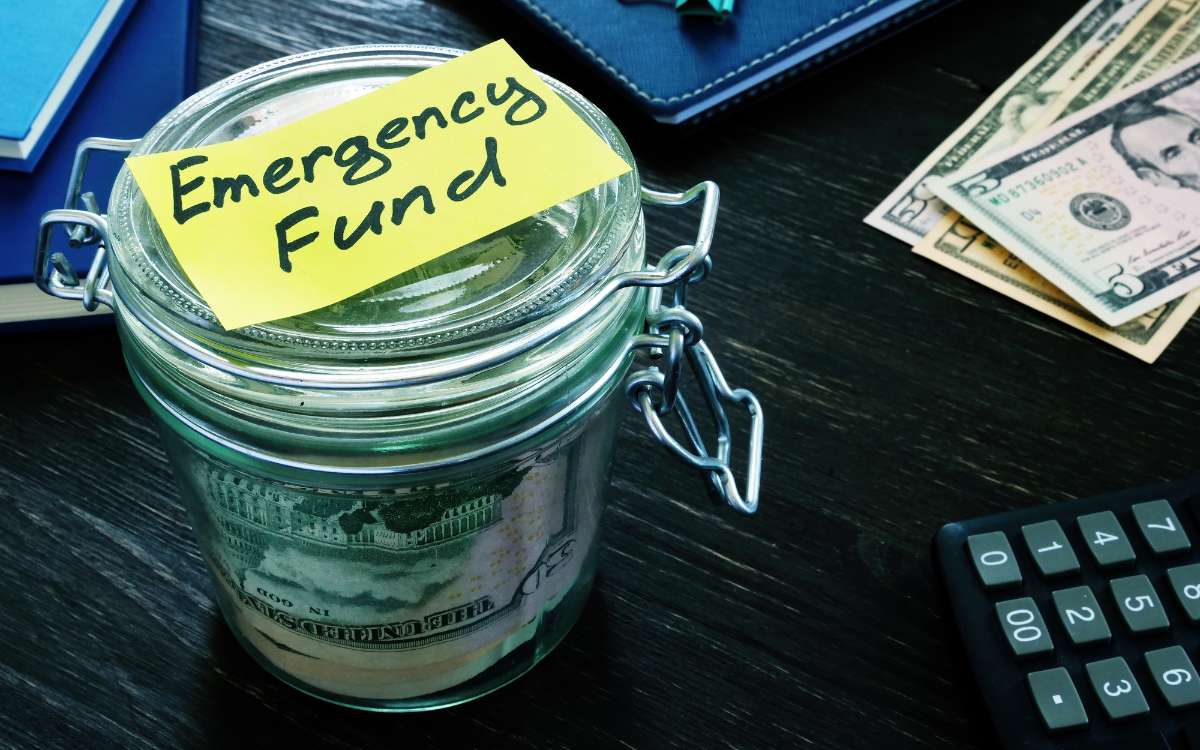
An emergency fund is money set aside for one job only: covering life’s genuine emergencies. Not Christmas. Not a sale at Farmers. Emergencies.
Think job loss, a car that fails its WOF and needs $1,200 of work before it’ll pass, a hot water cylinder that gives up on a Tuesday, or an unplanned trip to the vet. Anything you wouldn’t normally budget for that needs to be paid right now.
Having one means these things become annoying instead of catastrophic. That’s really the whole point.
Here’s what that actually looks like in real life, because it happened to me recently. Within a few weeks, our coffee machine died. Then the toastie maker. Then the rice cooker. The roof started leaking on top of that, and I ended up at the dentist with a bad tooth. It never rains, but it pours.
None of it was fun, and I wasn’t thrilled about the bill. But it also wasn’t a crisis, because the money to cover it was already sitting there, doing its one job.
That’s the entire value of an emergency fund summed up in one bad fortnight: it turns “how are we going to manage this” into “ugh, fine, sorted.” I was so bloody glad we had one.
How much should you have in an emergency fund?
There’s no single right number, but the general guide is three to six months of expenses.
Note I said expenses, not income.
If you actually lost your job, you’d cut your spending hard, not keep paying for takeaways and streaming subscriptions. My Irish mother-in-law has a saying for it: “you’d cut your cloth to suit your measure.”
You’d get by on less, because you’d have to.
That’s why I recommend pairing your emergency fund with a survival budget – a stripped-back version of your regular budget that shows exactly what you’d spend if income stopped tomorrow.
Once you know that number, your emergency fund target becomes obvious: three to six times your survival budget, not your normal one.
If three to six months feels miles away, don’t let that stop you starting. Save what you can. Most people find their funds grow faster than expected once they’re automated and out of sight.

Build your emergency fund in tiers
Three to six months of expenses is the end goal, not the entry point. If that number feels miles away, what you actually need is a clear next step, not a scary total.
Here’s the order I’d tackle it in.
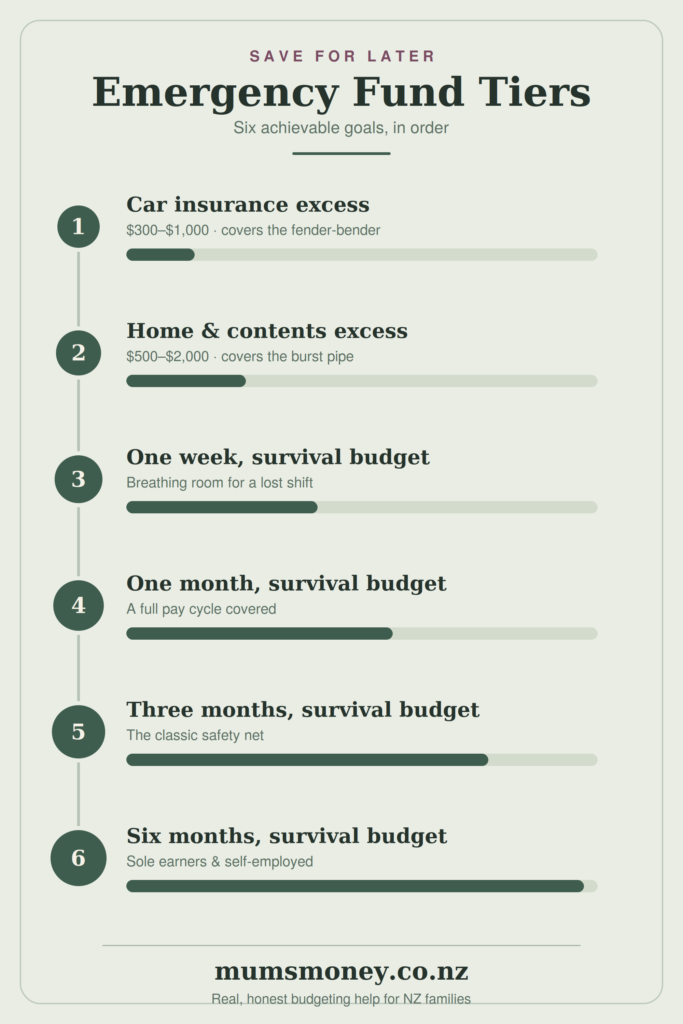
Tier 1: Your car insurance excess. Usually somewhere between $300 and $1,000, depending on your policy. This is the most common “oh no” bill most people hit – a prang in the supermarket car park, a scrape backing out of the driveway. Cover this and a car accident stops being a financial event and just becomes an annoying Tuesday.
Tier 2: Your home or contents insurance excess. Often $500 to $2,000, sometimes more if you’ve got a higher excess for natural disaster cover. A burst pipe, a storm-damaged fence, a break-in. Once this is covered on top of your car excess, the two most likely “life happens” bills are both sorted.
Tier 3: One week of your survival budget. Not your normal budget – your survival budget, the bare-bones version. One week’s worth gives you breathing room for a lost shift, a sick kid needing unplanned childcare, or a bill landing earlier than expected.
Tier 4: One month of your survival budget. This is the point where a genuinely bad turn – reduced hours, a slow month if you’re self-employed, a gap between jobs – stops being a crisis. You’ve got a full pay cycle covered.
Tier 5: Three months of your survival budget. The classic recommendation, and a solid safety net for most households.
Tier 6: Six months of your survival budget. Worth aiming for if you’re the sole income earner, self-employed, work in a field where jobs take a while to find, or you just sleep better with a bigger buffer. There’s no rule that says you have to stop at three.
Work through the tiers in order, and each one gets easier, because you’re not staring down one enormous number. You’re just covering the next bill you know is coming eventually anyway.
Where should you keep your emergency fund in 2026?
Somewhere separate from your everyday account, and somewhere you can get to quickly without jumping through hoops.
For years, savings rates in New Zealand were so low it barely mattered where you parked your emergency fund. That’s changing. The Reserve Bank lifted the Official Cash Rate to 2.50% in July 2026, its first increase in three years, and most bank economists expect it to keep climbing toward 3% by the end of the year.
A higher OCR generally means better returns for savers, so if you haven’t checked your savings account rate in a while, now’s a good time.
A few account types worth knowing about:
- On-call or e-saver accounts – full access any time, with a lower rate in exchange for that flexibility. Good for the fund itself.
- Bonus saver accounts – pay a higher rate if you don’t withdraw and you make a minimum deposit each month. Better return, but one slip-up can cost you the bonus for that month.
- Notice saver accounts – better rates again, but you have to give the bank 32 to 90 days’ notice before withdrawing. Not ideal for a true emergency fund, though handy for an overflow once your main fund is solid.
- PIE savings funds – interest is taxed at your Prescribed Investor Rate instead of your marginal tax rate, which can work out better if you’re on a higher income bracket.
Kiwibank, Heartland, Rabobank and Squirrel are among the banks and providers that regularly compete for savers’ cash with decent rates, but this changes often, so it’s worth a quick check on a comparison site like Canstar or interest.co.nz before you settle on one.
Whatever you choose, check it’s covered by the Depositor Compensation Scheme, which protects up to $100,000 per depositor, per institution, if a bank were to fail. Most registered banks and several non-bank deposit takers are covered.
What I wouldn’t do is put your emergency fund into the share market or a managed fund.
It’s tempting when you see what other investments can return, but this money needs to be there in full when you need it, not down 15% because the market had a bad month. Keep growth investing separate. This fund’s job is to be boring and reliable.
How to build an emergency fund when money is tight
Building this fund from nothing feels slow at first. It picks up speed. Here’s where to start.
Look hard at your spending. Go through your bank statement line by line. Subscriptions you forgot about, a grocery bill that’s crept up, small daily habits that add up over a month. You’re not looking for one big cut – you’re looking for a dozen small ones.
Work your tiers, not the total. Don’t look past your car insurance excess until it’s covered. Then don’t look past your home and contents excess. Momentum matters more than the size of the final number, and each tier is a genuinely achievable target on its own.
Sell what you’re not using. Facebook Marketplace, Designer Wardrobe, or a local buy-and-sell group. Most houses have a few hundred dollars of stuff sitting in cupboards doing nothing.
Do a few surveys. It won’t fund a house deposit, but sites like Octopus Group and PureProfile are solid options for Kiwis, and the payouts add up faster than you’d think when every dollar goes straight into your fund.
Automate it. Set up an automatic transfer from your everyday account to your emergency fund on payday, before you’ve had a chance to spend it. This one change does more heavy lifting than any amount of willpower.
Stash the extras too. Bargain at the supermarket and $13 left in your grocery budget? Into the fund. Sold the baby clothes? Into the fund. Every bit of unplanned money gets the same job.
The bottom line
An emergency fund isn’t glamorous. It won’t upgrade your lifestyle, and no one posts about it online. But it’s the one thing standing between a bad month and a genuine crisis, and right now, more Kiwis than ever are finding that out the hard way.
Start small if you have to. Automate it. Keep it separate, keep it accessible, and stop treating “I don’t have an emergency fund” as the norm. It’s an emergency in itself, and it’s worth fixing before you need it.
Related:
