
I burst into tears in my accountant’s office at 23.
I was filling out a loan application to pay a $5,000 tax bill I hadn’t saved for, and it was the first time I’d ever seen my whole financial mess written down in one place. Credit card debt, store cards, a personal loan, and nothing to show for any of it.
Nobody handed me a blueprint to a better financial life. I had to build one myself, with a credit card hangover, a library card and three jobs.
So if you’re starting from scratch with money, or starting over after a divorce, a redundancy, a health scare or just years of avoiding it, this is the plan I wish someone had handed me.
Seven steps, in order. You don’t need to be good with money to follow it. You just need to start at step one.
Step 1: Face your numbers
One evening. One piece of paper (or the notes app, I’m not fussy).
Write down four things:
- What comes in each week or fortnight
- What you owe (every card, loan, buy now pay later, overdraft, the lot)
- What you own (KiwiSaver balance, savings, car, house if you have one)
- What regularly goes out (rent or mortgage, power, food, phone, subscriptions)
This is the step everyone skips because it feels awful. It felt awful for me too.
But the numbers don’t get worse because you looked at them. They only get worse when you ignore them.
You can’t make a plan for money you refuse to look at.
Step 2: Check your KiwiSaver settings (the ten minute step)
Here’s the only step in this plan you can completely finish today.
Everything else happens over weeks and months. This one is a ten minute check, and then it works away in the background the whole time you’re doing the rest.
You don’t need to become an investing expert this year. You just need to make sure your KiwiSaver isn’t on autopilot in the wrong settings.
Three checks:
- Are you contributing? If you’re employed and contributing, you get employer contributions on top, plus the government contribution: 25 cents for every dollar you put in, up to $260.72 a year. To get the full amount you need to contribute $1,042.86 of your own money between 1 July and 30 June. That’s about $20 a week. Free money, sitting there, for a ten minute check.
- Are you in the right fund type? Funds range from defensive through conservative, balanced and growth to aggressive. If you’re decades away from using the money, growth-type funds are worth understanding. If you’re close to buying a first home or retiring, the conservative end is worth understanding. Use Sorted’s Fund Finder to compare. It’s government-backed and doesn’t take commissions.
- What are you paying in fees? Sorted’s numbers show the gap between the cheapest and most expensive funds can be around $99,000 over a KiwiSaver lifetime. Fees are one of the few things you can control.
This is general information only, not personalised financial advice. For advice specific to your situation, please speak with a licensed financial adviser.
Step 3: Protect the essentials
Now, back to the everyday money. Make sure four things are covered every single pay: your housing, your power, your food, and whatever gets you to work.
That’s it. Not the credit card minimum, not the gym, not the buy now pay later. If money is tight, these four come first and everything else waits its turn.
If you’re behind on any of them, don’t hide. Ring the power company and ask for a payment plan (they all have them).
Check what help you’re entitled to through Work and Income, even if you’re working.
Talk to your bank about hardship options if the mortgage is the problem. These systems exist because life happens, and using them is being smart, not being a failure.
Step 4: Give every dollar a job
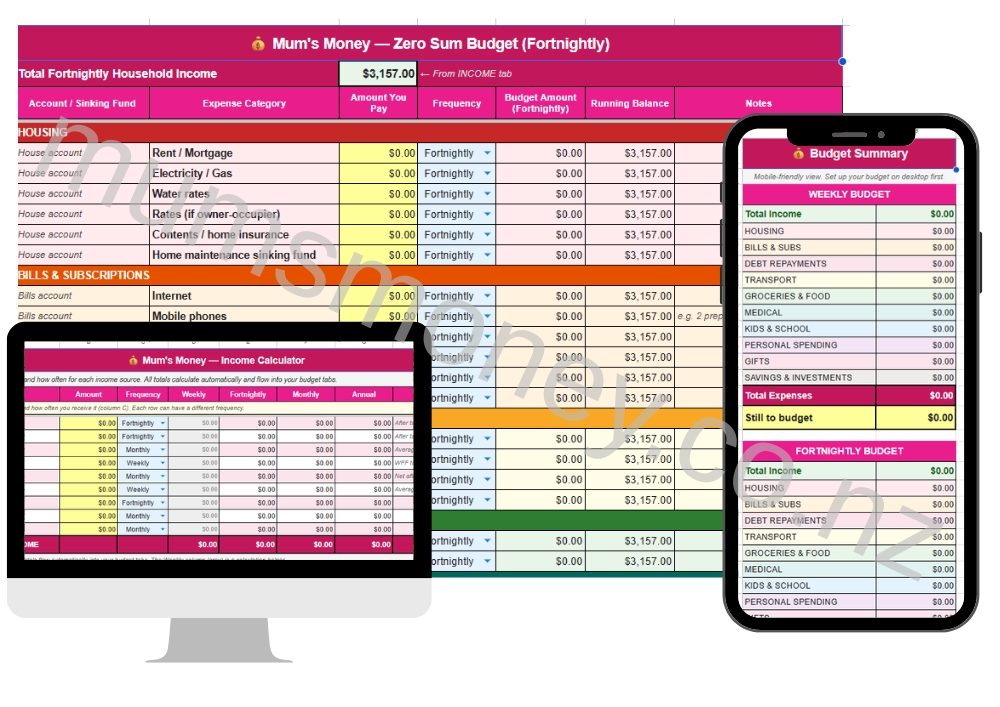
This is where a budget actually starts working: the zero-sum budget.
The idea is simple. Income minus everything you’ve allocated equals exactly zero.
Every dollar has a job before the pay period starts. Some dollars pay the rent, some buy groceries, some pay off debt, some go to savings, and some are allowed to be fun money (yes, really, fun money is a job too).
The reason budgets fail isn’t willpower. It’s that most budgets are vague. “Spend less on food” isn’t specific. “$220 for groceries this week” is. The system does the work so your willpower doesn’t have to.
Part of the setup is splitting your money across a few accounts, so each job has a home. One for bills, one for everyday spending, one for savings. (I actually have more like 20 banks accounts but that is my crazy, not yours – personal finance is personal).
Grab my free zero-sum budget spreadsheet and set up your first one, accounts and all. It’ll take about half an hour, and the first one will be wrong in places. That’s normal. Mine were too.
Step 5: Save your first $1,000
Your first financial goal is a starter emergency fund of $1,000. If you’ve never had an emergency fund, this is where you begin.
And yes, this comes before attacking the debt. Here’s why.
Without a buffer, every surprise (flat tyre, school camp, dentist) goes straight back on the credit card or bnpl, and you end up feeling like you’re going backwards even when you’re trying. A starter buffer of $1,000 breaks that cycle. It’s not your full emergency fund yet, it’s just enough to stop small surprises becoming new debt.
Can’t find much to save? Start with $1. $2 or $10 a week. That’s exactly where I started. It’s not about the amount, it’s about proving to yourself that you’re someone who saves now.
And treat it like a bill. Bills get paid. You don’t negotiate with the power company, you pay it. Set up an automatic $10 a week into your emergency fund the day you get paid.
(To be clear – your emergency fund should be a separate but easily accessible bank account).
Step 6: Knock out the expensive debt
Now the debt, and we do it with a list, not with shame.
Write every debt down with its balance and interest rate. Credit cards, store cards, buy now pay later, car loans, personal loans. Then pick your order:
- Smallest balance first if you need wins to stay motivated (most people do) – this is called the Debt Snowball
- Highest interest rate first if you’re a spreadsheet person and want the mathematically fastest route
Either works. The one you’ll stick to is the right one.
Pay minimums on everything, then throw every spare dollar at the top of your list. When one’s gone, roll its payment into the next. It snowballs faster than you’d think.
When I finally paid off my credit card, I walked into the bank branch and paid the last of it in cash. I still remember how that felt. That feeling is coming for you too.
Step 7: Build the real buffer, then look up
Once the expensive debt is gone, your next priority is growing that $1,000 starter buffer into a proper emergency fund of three months of essential expenses.
This is the thing that turns a redundancy or a sick kid from a crisis into an inconvenience.
Then, and only then, you get to look up. Investing beyond KiwiSaver. Extra mortgage payments. The house deposit. The trip you’ve been putting off since forever.
You’re a saver now, and you don’t have bad debt. You can do literally anything!
Extra step for extra credits:
Start tracking your net worth once a month: everything you own minus everything you owe. I’ve tracked mine since 2015, when it was about $340k. It’s over $1.4M now.
Not because of one big move, but because I could see the number and I wanted it to go up. What gets measured gets managed, even when the number starts out negative.
If you’re starting over, not starting out
Maybe you had it sorted once and life blew it up. Divorce, redundancy, illness, a business that didn’t work, a partner who handled all the money so you never learned.
The plan is exactly the same, and here’s what I want you to know: you are not behind. I started this plan with a negative net worth and a tax bill I paid for with a loan. The starting line doesn’t matter as long as you are moving forward.
Start at step one. One piece of paper. Tonight.
