I get asked about this a lot, so I figured it was time to just lay it all out.
This is not a “you should do this too” post. Personal finance is personal, and what works for our family is specific to our situation.
But I’m a big believer in transparency – because when I was starting out, I would have loved to see exactly what someone further down the road was actually doing.
So here it is. How we invest, in plain language, no filter.
Part 1: ETFs
We keep this part really simple. All of our ETF investments go into the Foundation Series Total World Fund through InvestNow.
ETFs (Exchange-Traded Funds) are how we invest in shares without picking individual companies – instead of choosing which businesses to buy, you buy a tiny slice of thousands of them in one go.
This fund invests 100% into the Vanguard Total World Stock ETF, which holds shares in large, mid-sized and small companies listed on stock markets all over the world. When you put money in, you’re buying a tiny piece of basically the entire global share market in one go.
Here’s why we like it:
It’s cheap. The total fund charges are 0.06% per year – one of the lowest in New Zealand. There’s a 0.50% buy/sell transaction fee, but no performance fees and no ongoing spread.
It’s diversified. One fund, thousands of companies across the whole world. No trying to pick winners.
It’s passive. It just tracks the global market. We’re not paying someone to actively manage it and take a bigger fee for the privilege.
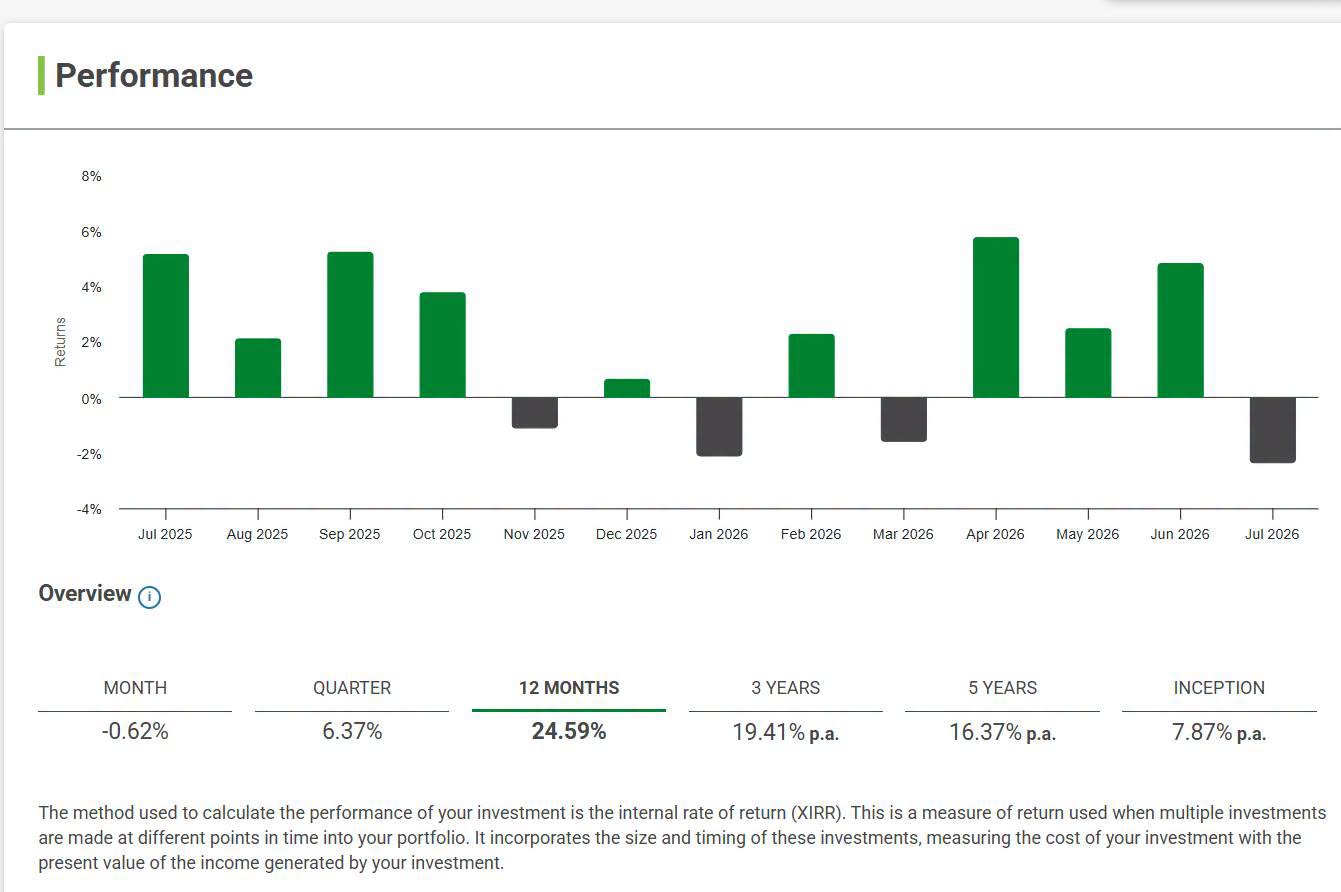
Here’s what it’s actually returned for us – these are our real numbers from our InvestNow dashboard:
- 12 months: 24.59%
- 3 years: 19.41% p.a.
- 5 years: 16.37% p.a.
We’re not doing anything clever. We’re just chucking money in each week, staying in and letting it do its thing.
We’ve been investing in a version of this fund through Smartshares since early 2016, so we’re very comfortable with how it behaves – including the dips (March 2020, I’m looking at you!).
And when we eventually start selling our investment properties, this is exactly where those proceeds will go.
This is a long-haul fund for us. We have no plans to touch it until we hit our early retirement goal – which means we can ride out the bad years without panicking, because we’re not going to need the money anytime soon.
One thing worth mentioning: going 100% into growth ETFs is right for us, but not for everyone.
Our investment properties serve as the stable, income-generating part of our portfolio, so we can afford to go all in on growth here. More on that below.
Part 2: Property
We own four rental properties – three in Christchurch, one on the West Coast (and an additional house we live in, also on the West Coast SI).
All bought between 2006 and 2020, and at the beginning of that period property was basically the only accessible path to building wealth for people like us.
One thing that might surprise you: we’ve never set out to buy a first home. We’d always rented where we live and invested elsewhere – what’s sometimes called rent-vesting.
We did end up moving into one of our rentals (the one we’ve owned the longest right now), but that was never the intention when we bought.
Every deposit was saved in cash from scratch until the most recent three properties.
We bought from afar, which added its own complications, but it meant we could buy where the numbers made sense (New Zealand) rather than where we happened to live (Australia, for much of that time).
The capital growth has been good. We bought these properties for well under what they’re worth now, and that equity is a big part of how we hit our net worth goal. On paper, it looks great.
The cash flow is fine. All four are cash flow positive overall – rents cover the mortgages, rates, insurance, management and maintenance with something left over. One runs at a small monthly loss. One is the clear star. The others sit somewhere in the middle.
This is why I say property is not passive income. We have brilliant property managers and couldn’t do this without them.
But even with great managers, it’s still a business. It requires our time, our attention, our decisions. That’s not passive.
And then there’s the lowkey dread that every landlord knows – the moment a tenant gives notice in a slow market. Even when you do everything right, that feeling doesn’t go away.
We’ve always rented slightly below market rate and looked after our tenants well, which means most of ours have stayed for years. Because a good long-term tenant is worth far more than squeezing every last dollar out of the rent.
But even so, vacancies happen. And when they do, all that “passive income” disappears fast.
So why keep them?
Because in our overall investment strategy, our properties play a specific role – they’re our equivalent of bonds. The stable, income-generating, lower-volatility part of our portfolio.
That’s what lets us go 100% into growth ETFs in Part 1.
We also pay principal and interest on all but one of our loans – so we’re actively paying them down, not just holding them. Equity grows from both ends: the market doing its thing and the debt shrinking every month.
Over the next decade, we plan to sell two or three of them and move the proceeds straight into our Total World Fund. Slowly, deliberately, shifting from bricks and mortar to something more liquid, more flexible, and frankly less stressful.
Would I start in property today if I was starting from scratch? Honestly, no.
The platforms that now make share investing accessible to everyone – Sharesies, InvestNow, Kernel – didn’t exist when we started.
Property was what we knew, and it got us here. But the maths is harder now, the costs are higher, and the back-and-forth on interest deductibility makes it hard to plan with confidence. When the rules keep changing, it’s hard to build a strategy around them.
Plus, the flexibility just isn’t there compared to shares. You can’t quickly liquidate a rental property to fund a 13-month family trip. We learned that lesson the hard way.
I do want to say this: I hate the way landlords are vilified. Most of us are just ordinary people who were trying to get ahead the only way we knew how at the time. We weren’t trying to ruin the housing market. We were trying to build a future for our families with the tools available to us.
Related: Case Study: Cashflow Positive Property in Christchurch (a good read if you’re interested in the detailed numbers of an investment property).
View this post on Instagram
Part 3: KiwiSaver & Australian Super
KiwiSaver
My strong opinion here is that if you’re not in it, get in it. At minimum, contribute enough to get the full government contribution.
That’s $1,042.86 a year each (about $20 a week), which gets you $260.72 of free money from the government. It’s not a huge amount, but it’s a 25% instant return on that money. There is no easier win in personal finance.
We’re both self-employed, so we don’t get employer contributions. But we still put in that minimum every week, without fail. Free money is free money.
As for which fund — I’m in the Foundation Series Total World Fund through InvestNow (yes, same as Part 1 — I like to keep things simple).
My husband is in the Simplicity High Growth Fund. Both are growth funds, because we’re not touching this money for a long time and we can afford to ride out the volatility.
Australian Super
We both lived in Australia for years, which means we both have Australian superannuation sitting over there. For now, we’re leaving it exactly where it is – and here’s why.
The full balance will be available to us at age 60, as long as we’re retired by then. Which we plan to be. And once we’re 60, withdrawals from Australian super are generally tax-free.
There’s also a tax advantage while the money is still growing. Investment earnings inside Australian super are taxed at 15% – compared to the 28% PIE tax rate we pay on our KiwiSaver and NZ fund investments. That difference compounds meaningfully over time.
If we transferred it into KiwiSaver, only the transferred amount would be accessible at 60. Any growth on that money would get mixed into the regular KiwiSaver pot – and that portion wouldn’t be available until 65. So by transferring, we’d actually be locking some of our own money away for longer than necessary, and giving up the tax advantage in the process.
One thing we did do: remove the insurance portions of our policies. There were limits on what the insurance would pay out given we’re no longer living in Australia, so we were essentially paying for cover that wouldn’t have worked for us anyway.
Since removing it, our balances have only grown – with no insurance premiums eating up our returns each month.
We keep a close eye on both balances as part of our monthly net worth tracking, and we’ll optimise as we go. But for now, they stay in Australia. I could change my mind on this at any time.
Part 4: Emergency Fund & Savings
The standard advice for an emergency fund is 3-6 months of expenses in cash. And when you’re starting out, I think that’s bang on – having that buffer is what keeps a financial wobble from becoming a financial disaster.
But our setup looks a bit different now, and here’s why.
We keep a small amount in cash in our offset account and more in an easily accessible fund. On paper, that sounds a bit thin. But there’s a principle behind it: we want every dollar working hard, even the emergency fund. Money sitting in an offset account saves us interest on the mortgage every single day.
Our overall safety net also has more layers than one account. We have credit cards we pay off in full every month, which means the limits are almost always fully available if something urgent comes up.
In practice, we’d put the emergency on the card first – giving us immediate access to funds – and then repay it from the accessible fund once we’d assessed the situation.
And our rental income doesn’t just stop overnight. Unlike a salary, it keeps coming in while you sort things out. If things got really tight, we’d also revert to our survival budget – stripping costs back to the absolute essentials.
This approach won’t be right for everyone – and if you’re earlier in your financial journey, please build that cash buffer first before anything else. But as your wealth grows, your emergency fund strategy can evolve too.
Where we’ve landed: Coast FIRE
When you add it all up – the ETFs, the rental properties, the KiwiSaver, the Australian super – we’ve crossed into what the personal finance world calls Coast FIRE.
It means our investment pot is now large enough that, left alone to compound at a conservative growth rate, it will become more than we need by retirement age without us adding another dollar.
We got here by making a deliberate call early on to frontload our investments hard – boring and reliable car, small house, saying no to a lot – so that compounding could do the heavy lifting later. Now our job is simply to cover our living costs and stay out of the pot’s way. No guilt. No panic when the market dips. Just patience.
Related: We Just Semi Retired (These Are Our Actual Numbers)
This is not financial advice. Personal finance is personal, and I’m sharing what works for us to hopefully inspire people to think more about how to maximise their own financial situation.
Need to talk it through?
I’m not a financial advisor and I can’t tell you what to invest in. But I am someone who thinks about money constantly, has made plenty of mistakes, and loves helping people figure out their next move.
Think of me as your money-obsessed friend. No courses to sell you, no upsell, no sales funnel. Just a paid chat where you can bounce ideas, ask all the questions, and hear what I’d actually do in your situation.
